When people think of Ladakh superfoods, Sea Buckthorn usually comes to mind first. Any plant surviving Ladakh’s brutal -30°C winters at 12,000 feet has to build powerful internal defenses just to stay alive.
Ladakh Alfalfa (Medicago sativa) grows in that exact same cold desert. When bees forage on its purple blossoms during Ladakh’s short summer, the honey carries the natural strength of that extreme survival.
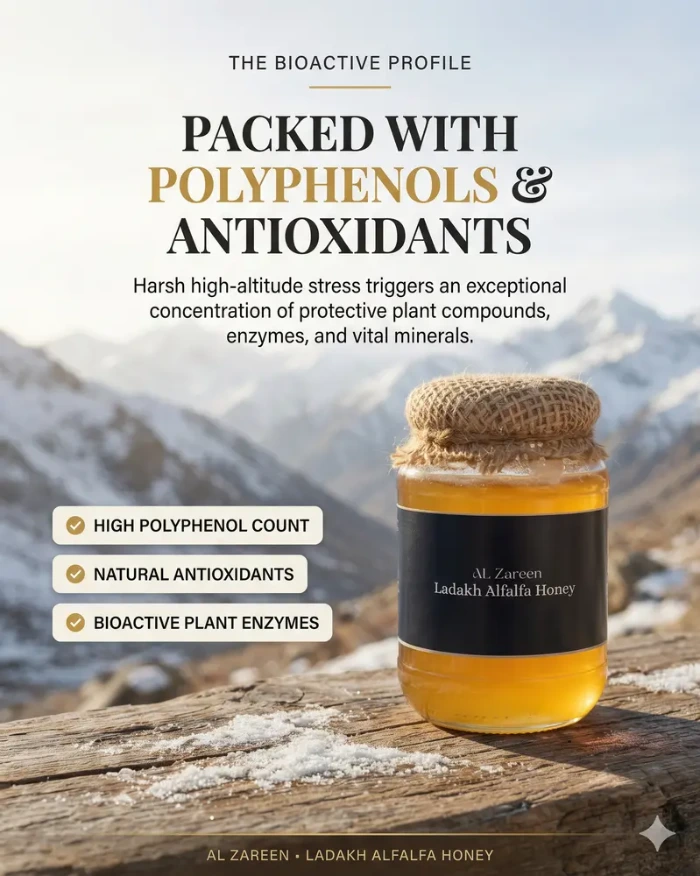
Why -30°C Blooms Pack Stronger Polyphenols
Unlike flowers in mild plains, high-altitude Ladakh alfalfa survives sub-zero winters (-30°C), intense UV radiation, and sharp day-to-night temperature swings.
To protect against freezing and UV damage, both Sea Buckthorn and Ladakh Alfalfa produce high levels of polyphenols and flavonoids—natural antioxidants that transfer directly into alfalfa nectar. (To be completely honest: alfalfa honey comes from alfalfa blossoms, not sea buckthorn berries, though both share Ladakh’s extreme climate advantage.)
Taste, Colour & Honest Origin
Compared to darker forest or Kashmir Valley honeys, pure Ladakh alfalfa honey is noticeably lighter:
Colour & Taste: Pale gold to light amber, with a clean, mildly floral sweetness and zero heavy aftertaste.
True Origin: Harvested in Ladakh—making it a distinct high-altitude Ladakhi harvest rather than a Kashmir Valley honey.
Crystallization & Mild Filtration
Natural setting: Higher natural glucose makes alfalfa honey turn creamy in cool weather. That is a sign of pure floral honey—just warm the jar gently in water to melt it back.
Mild filtration: Gentle coarse straining without high heat removes stray beeswax particles while keeping natural pollen and polyphenols intact.